Masonry has played a crucial role in construction for thousands of years. From ancient fortifications to modern buildings, stone masonry remains one of the most reliable and durable building techniques. Among the various types of masonry used today, rubble masonry stands out as a practical and cost-effective solution for many structural and architectural applications.
Rubble masonry involves constructing walls using rough, irregularly shaped natural stones bonded together with mortar. Unlike polished or precisely cut stonework, rubble masonry uses stones in a more natural form, which makes the construction process more economical while still providing strong structural integrity.
In commercial construction, rubble masonry is commonly used for retaining walls, foundations, landscape structures, perimeter walls, and decorative architectural elements. Its combination of durability, strength, and natural aesthetics makes it an excellent choice for many commercial projects.
This guide explains what rubble masonry is, the different types used in construction, its advantages and limitations, and how it is applied in modern commercial construction projects.
What Is Rubble Masonry?
Rubble masonry is a construction technique where irregularly shaped stones are arranged and bonded together using mortar to form strong walls or structural elements. These stones are typically used with minimal shaping or dressing, allowing builders to utilize natural materials efficiently.
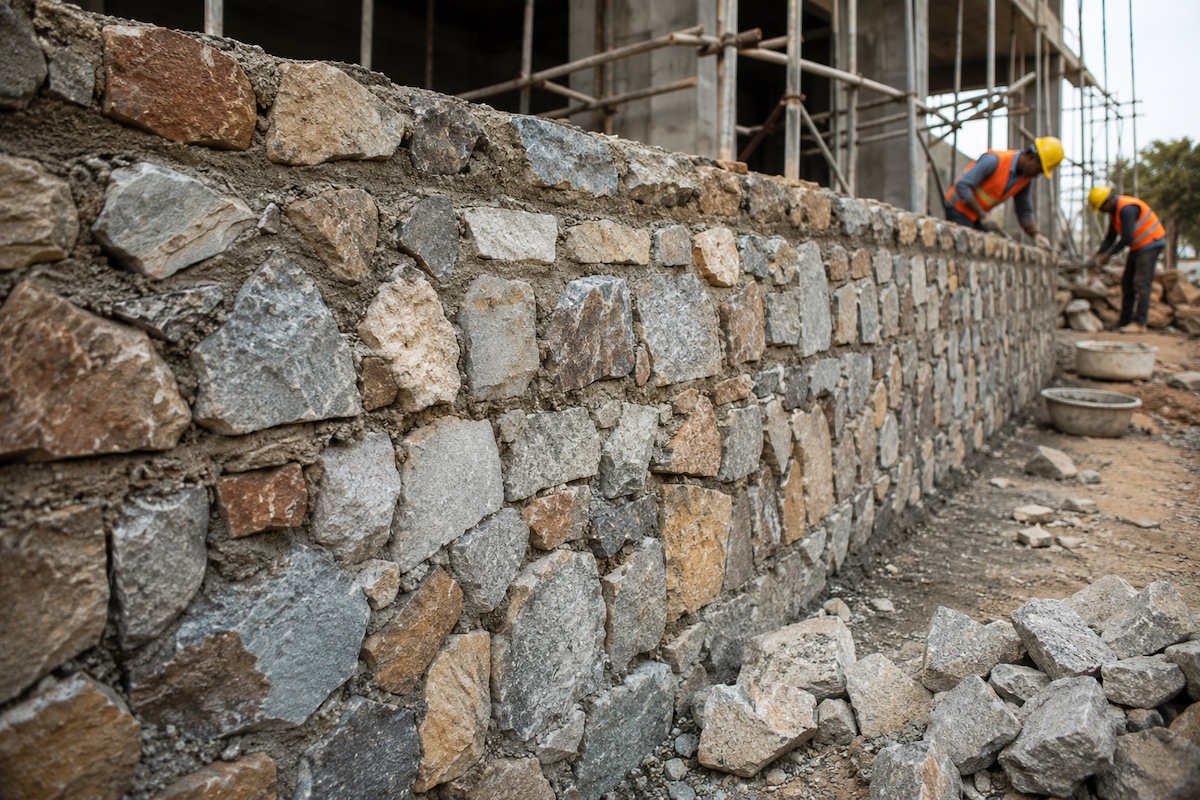
Because stones vary in size and shape, they are carefully arranged to ensure proper bonding and structural stability. Skilled masons place the stones strategically so that they interlock and distribute loads effectively.
Key Characteristics of Rubble Masonry
Rubble masonry has several distinctive characteristics that make it different from other masonry techniques:
- Irregular stone shapes that are minimally processed
- Thicker mortar joints used to fill gaps between stones
- Natural and rustic appearance that blends well with outdoor environments
- Strong load-bearing capacity due to the durability of natural stone
- Cost-effective construction since stones require less processing
These features make rubble masonry a practical choice for both structural and decorative commercial construction projects.
How Rubble Masonry Differs From Ashlar Masonry
Rubble masonry is often compared with ashlar masonry, another common stone construction method. While both use natural stone, the preparation and placement of stones differ significantly.
Ashlar masonry uses carefully cut stones with smooth surfaces and uniform shapes. These stones are laid with thin mortar joints, creating a refined and highly precise appearance.
Rubble masonry, on the other hand, uses rough or partially dressed stones, which creates a more natural and rustic look. Because rubble masonry requires less processing of materials, it is often more economical and easier to construct than ashlar masonry.
While ashlar masonry is commonly used in highly decorative architectural structures, rubble masonry is frequently used for foundations, retaining walls, and landscape features in commercial construction.
Types of Rubble Masonry Used in Commercial Construction
There are several types of rubble masonry used in construction, each suited for different structural and aesthetic purposes.
Random Rubble Masonry
Random rubble masonry is one of the most widely used types.
Uncoursed Random Rubble Masonry
In this method, stones are laid without maintaining uniform horizontal layers. Stones of different sizes are placed in a way that ensures stability and strength.
This type is commonly used for foundations, retaining walls, and rural construction projects.
Coursed Random Rubble Masonry
In coursed random rubble masonry, stones are arranged in rough horizontal layers or courses. While the stones remain irregular, the courses create a more organized structure and improved visual appearance.
Square Rubble Masonry
Square rubble masonry involves stones that are roughly shaped into rectangular or square forms before being placed.
Coursed Square Rubble Masonry
Stones are arranged in horizontal courses, resulting in a stronger and more structured wall. This type is often used for exterior walls in commercial buildings.
Uncoursed Square Rubble Masonry
In this variation, stones are roughly squared but placed without strict horizontal alignment. The structure still maintains stability while retaining a natural appearance.
Polygonal Rubble Masonry
Polygonal rubble masonry uses stones shaped into irregular polygonal forms that fit closely together. The result is a visually appealing pattern that is often used in decorative facades and landscape walls.
Flint Rubble Masonry
Flint rubble masonry uses rounded flint stones, which are naturally durable and weather-resistant. While more common in historic architecture, it may still appear in decorative construction projects.
Materials Used in Rubble Masonry Construction
The quality of materials used significantly affects the strength and longevity of rubble masonry structures.
Natural Stones
Common stones used in rubble masonry include:
- Granite
- Sandstone
- Limestone
- Basalt
- Quartzite
These stones are selected based on strength, durability, and availability in the region.
Mortar Used in Rubble Masonry
Mortar binds the stones together and plays an essential role in structural stability.
Cement Mortar
Cement mortar is widely used in modern commercial construction because of its strength and durability.
Lime Mortar
Lime mortar offers greater flexibility and is often used in restoration or heritage structures.
Cement-Lime Mortar
This combination provides both strength and flexibility, making it suitable for many structural masonry applications.
Construction Process of Rubble Masonry Walls
Building a rubble masonry wall involves several steps to ensure the structure remains stable and durable.
Site Preparation
The first step involves preparing the construction site. This includes excavation, leveling the ground, and marking the foundation layout.
Stone Selection and Preparation
Stones are sorted according to size and strength. Larger stones are typically used at the base of the structure, while smaller stones fill gaps between larger pieces.
Laying the Stones
Construction begins by placing larger stones at the foundation level. Stones are arranged carefully to interlock with each other, ensuring the structure can distribute loads properly.
Mortar Application
Mortar is applied between stones to fill gaps and bond the stones together. Proper mortar placement is essential for preventing structural weaknesses and water penetration.
Joint Finishing
The final step involves finishing the mortar joints through pointing techniques, which enhance durability and improve the wall’s appearance.
Structural Advantages of Rubble Masonry in Commercial Construction
Rubble masonry provides several advantages that make it suitable for commercial construction projects.
High Load-Bearing Capacity
Natural stone has excellent compressive strength, allowing rubble masonry walls to support significant loads.
Exceptional Durability
Stone structures are highly resistant to weathering, erosion, and environmental stress, allowing them to last for decades or even centuries.
Cost Efficiency
Because rubble masonry uses minimally processed stones, it can reduce material and fabrication costs compared to more refined stonework.
Thermal Mass Benefits
Stone walls absorb and release heat slowly, which helps regulate indoor temperatures and improves energy efficiency.
Fire Resistance
Natural stone offers excellent fire resistance, providing additional safety in commercial structures.
Common Commercial Applications of Rubble Masonry
Rubble masonry is widely used in several types of commercial construction projects.
Retaining Walls
Retaining walls help stabilize slopes and control soil movement. Rubble masonry is commonly used for these structures due to its strength and durability.
Foundation Walls
Rubble masonry foundations provide strong support for smaller commercial structures.
Boundary and Perimeter Walls
Many commercial properties use rubble masonry for security and perimeter walls because of its durability and natural appearance.
Decorative Facades
Rubble masonry can also be used for architectural features and exterior facades, adding natural texture and character to commercial buildings.
Infrastructure Projects
Historically, rubble masonry has been used in bridges, culverts, and other infrastructure structures, particularly in areas where natural stone is readily available.
Limitations of Rubble Masonry
Although rubble masonry has many advantages, it also has certain limitations.
Labor-Intensive Construction
Because stones vary in shape and size, construction requires skilled masonry workers to ensure proper placement and stability.
Higher Mortar Consumption
Irregular stone shapes create gaps that require more mortar compared to other masonry techniques.
Less Precision
Rubble masonry cannot achieve the same level of precision as ashlar masonry, which uses precisely cut stones.
Height Limitations
Rubble masonry is generally used in low- to medium-height structures rather than very tall buildings.
Sustainability Benefits of Rubble Masonry
Rubble masonry also supports sustainable construction practices.
Use of Natural Materials
Natural stone requires minimal industrial processing, reducing energy consumption.
Reduced Carbon Footprint
Stone construction generally produces lower carbon emissions compared to many modern construction materials.
Long Service Life
Stone structures can last for generations, reducing the need for frequent reconstruction.
Reusable Materials
Stones can often be reclaimed and reused, making rubble masonry environmentally friendly.
Conclusion
Rubble masonry remains an important construction method because of its strength, durability, cost efficiency, and natural beauty. From retaining walls and foundations to architectural stone features, this traditional technique continues to serve modern commercial construction projects effectively.
At Leidal & Hart, we recognize the value that quality masonry brings to commercial buildings and infrastructure. Our team has extensive experience delivering professional commercial masonry services, from structural stonework to detailed architectural masonry solutions. By combining skilled craftsmanship with reliable construction practices, we ensure that every project meets the highest standards of durability and performance.
Whether you are planning a commercial development, enhancing a property with natural stone features, or constructing retaining walls and structural masonry, working with experienced professionals is essential. At Leidal & Hart, we are committed to delivering dependable masonry solutions that support the long-term success of commercial construction projects.