Mortar bonds brick, block, and stone at their joints. Masonry grout fills specified cores and spaces within a wall, including spaces around steel reinforcement. Mortar is workable enough to spread and hold masonry units in position; grout is fluid enough to reach the spaces it must fill. Both contribute to the completed masonry system. Brick Industry Association: masonry terminology.
For a commercial project, the question is often where each material belongs. A reinforced concrete block wall typically uses both. Confusing their roles can lead to the wrong material order, incomplete grouting, or a repair that does not address the problem.
This guide focuses on mortar and grout for commercial masonry walls. Tile-setting mortar and tile grout are separate products with different applications.
Mortar vs. Grout: A Quick Comparison
| Comparison | Masonry mortar | Masonry grout |
|---|---|---|
| Main purpose | Bonds and beds masonry units | Fills designated spaces and bonds reinforcement to the surrounding masonry |
| Typical location | Horizontal bed joints and vertical head joints | Specified CMU cores, bond beams, and spaces in grouted masonry construction |
| Fresh consistency | Plastic and spreadable; stays in place during laying | Fluid and cohesive; flows into the required spaces |
| Aggregate | Fine aggregate, usually sand | Fine aggregate, or fine and coarse aggregate |
| Common classifications | Types M, S, N, and O | Fine or coarse; conventional or self-consolidating |
| Main material specification | ASTM C270 | ASTM C476 |
| Interchangeable? | Do not substitute for specified grout | Do not substitute for specified laying mortar |
The material specifications distinguish mortar for unit masonry from grout for masonry. Their similar appearance does not make them equivalent.
What Is Mortar in Commercial Masonry?
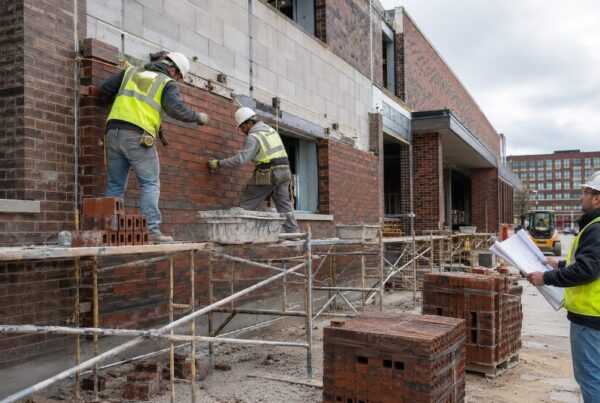
Masons spread mortar between units as they build a wall. It beds each course, accommodates small variations in unit dimensions, and bonds adjacent units.
The horizontal joint beneath a unit is the bed joint. The vertical joint between units is the head joint. These are the visible mortar lines in conventional brickwork and concrete block construction.
Masonry mortar contains cementitious materials, sand, and water. Depending on the specified mix, its binder may use cement with lime, masonry cement, or mortar cement. Those ingredients influence how the mortar spreads, retains water, and develops bond.
Good mortar needs suitable properties while fresh and after it hardens. It must let the mason position units and make effective contact with their surfaces. In service, it contributes to the wall’s strength, durability, and resistance to water penetration. Brick Industry Association: Mortars for Brickwork
What Is Masonry Grout?
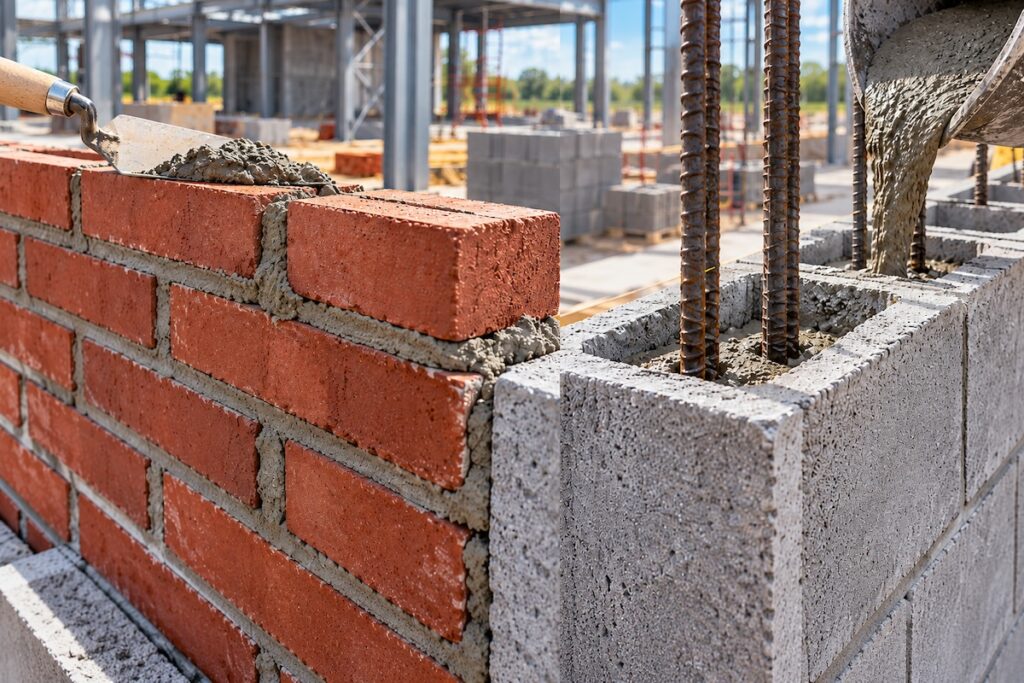
Masonry grout is a fluid cementitious mixture placed inside designated spaces in the masonry. In reinforced concrete masonry, it surrounds reinforcing bars and bonds them to the surrounding units so the components can act together.
Common locations include reinforced vertical cores and horizontal bond beams. A bond beam is a reinforced, grouted masonry member that helps carry or distribute forces along a wall.
A grout mix must reach the specified spaces without leaving significant voids. That makes its flow, aggregate size, placement, and consolidation important parts of construction. SPEC MIX: Core Fill Masonry Grout
If you are reviewing a block-wall proposal, ask which cells and courses require grout. The answer comes from the wall design. A reference to a “CMU wall” alone does not tell you whether it is partially or fully grouted. Our guide to concrete masonry units and their uses explains the broader system.
Why Masonry Grout Is Different From Tile Grout
The word “grout” describes several products used in construction. Their intended uses matter more than the shared name.
Tile grout fills the joints between installed tiles. Masonry core-fill grout fills designated spaces within masonry walls. Products for equipment bases, anchors, or specialty repairs also have their own requirements.
For example, a commercial restroom may have tile joints on its finished surface and reinforced CMU behind it. The grout used between the tiles is not the material specified for the reinforced block cores.
On purchase orders and submittals, use the full product description and applicable specification. “Grout for the wall” leaves too much room for misunderstanding. ASTM C476 identifies the grout covered for masonry construction. ASTM C476 scope
Mortar Types and Grout Types: Two Different Classifications
Mortar Types M, S, N, and O
Mortar types describe different combinations of material properties. Broadly:
| Mortar type | General characteristic |
|---|---|
| Type M | High compressive strength |
| Type S | Higher compressive and flexural bond strength than Type N |
| Type N | General-purpose mortar with good workability and bonding characteristics |
| Type O | Lower-strength mortar used in certain interior and restoration applications |
These descriptions are a starting point. Selection must account for the masonry units, exposure, loads, and project requirements. A higher-strength mortar is not automatically the better choice. The Brick Industry Association recommends selecting the lowest compressive-strength type that meets the project requirements. BIA: mortar selection and quality assurance
For a closer look at two commonly discussed options, see our guide to Type S vs. Type N masonry cement.
Fine and Coarse Masonry Grout
Fine grout uses fine aggregate. Coarse grout includes both fine and coarse aggregate. The available grout space, reinforcement, and placement requirements influence which mix is suitable.
There is also a separate distinction between conventional grout and self-consolidating grout. Both can be fine or coarse. ASTM C476 recognizes these categories and specifies different approaches to their qualification. ASTM C476
Self-consolidating grout is formulated to flow through the required spaces without mechanical consolidation. It is not ordinary grout with extra water added. Its fluidity and resistance to segregation depend on the designed mix. SPEC MIX: self-consolidating grout
How Mortar and Grout Work Together in a Commercial Wall
Consider an illustrative commercial wall with a brick exterior and reinforced CMU backing:
- Mortar beds and bonds the CMU units. The blockwork is built in courses with the specified joints.
- Grout fills the designated reinforced spaces. These may include vertical cores and bond-beam courses.
- Mortar also forms the joints in the brick exterior. The brick layer has its own support, attachment, and moisture-management details.
- The designed drainage space stays open. The space behind a drained brick veneer serves a different purpose from the grouted spaces inside the backing wall.
This example illustrates why “fill the wall cavities” is an incomplete instruction. The drawings need to identify spaces that receive grout and spaces reserved for drainage or other functions. BIA: Water Penetration Resistance—Design and Detailing
The example is not a Leidal & Hart project specification. Actual grout locations, reinforcement, and wall details vary by design.
Can Mortar and Grout Be Used Interchangeably?
Do not substitute mortar for specified masonry grout, or grout for specified laying mortar. A mix that works well in a joint may not flow properly around reinforcing steel. A fluid core-fill mix is not selected for holding units in position during laying.
Adding water to mortar does not establish that it meets the grout specification. Nor does a high compressive-strength result establish that a material is suitable for every masonry application.
When a proposed substitute arises, the useful question is: “Does this product meet the specified requirements for this exact use?” Resolve that through the project’s material-submittal and approval process before placement. BIA guidance distinguishes the two materials by both function and specification. BIA: mortar and grout
What Matters During Installation and Quality Control?
Check the Mortar Against the Correct Requirements
ASTM C270 provides alternative proportion and property specifications for mortar. A field mortar sample should not be judged by directly comparing its compressive strength with laboratory property-specification values.
That distinction matters when a test report raises questions. Before calling material defective, confirm the sampling method, test method, and acceptance criteria. The ASTM scope expressly explains the limits of field strength testing for C270 compliance. ASTM C270
Plan How Grout Will Reach the Required Spaces
Grouting needs coordination before the placement starts. The crew needs access, the specified mix, clear grout spaces, and an agreed sequence for placing and inspecting the work.
For conventional grout, follow the required consolidation and reconsolidation procedures. Consolidation helps eliminate voids; reconsolidation addresses initial settlement where required. Approved self-consolidating grout follows its own placement and testing requirements. A fluid appearance alone is not a reason to skip the specified process. SPEC MIX: grout placement guidance
A practical preplacement discussion should settle who will check reinforcement, who will arrange testing, and when inspection can occur. That prevents the crew from discovering an unresolved requirement after delivery.
Michigan Weather: Why Protection Matters for Both Materials
Michigan projects need to account for weather during construction, as well as exterior exposure after the building is complete.
Mortar and grout harden through reactions involving cement and water. Cold conditions slow strength development, and freezing can damage fresh work. Hot, drying conditions can also disrupt performance by removing water too quickly. Weather protection therefore belongs in the construction plan.
Depending on conditions and the applicable requirements, the plan may address protected storage, heated materials, enclosures, temperature monitoring, and protection of newly built masonry. A dry-looking joint does not establish that the work has developed the required strength. BIA: Hot and Cold Weather Construction
For exterior walls, the design must also manage water over the building’s life. Mortar and grout do not replace flashing, drainage, and properly detailed transitions. Selecting the material is only one part of creating a durable wall. BIA: water penetration resistance
Mortar vs. Grout Cost: What Should You Compare?
A bag-price comparison has limited value because mortar and grout serve different purposes and are used in different quantities.
For a commercial estimate, separate the scope into questions such as:
- How much masonry will be laid, and what joints and finishes are specified?
- Which cells and courses require grout?
- What delivery, mixing, and pumping arrangements are included?
- How will crews access the work?
- What testing, inspection, and weather protection are required?
- Does the work involve new construction or repairs to an occupied building?
For example, two proposals for the same wall area may include different amounts of grouting or different access arrangements. They are difficult to compare until those assumptions are made explicit.
Request pricing against the same drawings and specifications. Our guide to commercial masonry costs in Michigan covers other factors that can affect the project budget.
Which Material Is Used to Repair Brick Joints?
Deteriorated mortar joints are generally repaired with a compatible repointing mortar. Selecting that mortar requires attention to the existing masonry, especially in older buildings. A harder replacement material can create problems when it is incompatible with the original brick and mortar. BIA: mortar selection for repointing
If a repair proposal uses “grouting” to describe visible joint repairs, ask what product and method it actually includes. A trade description is not enough to identify a suitable material.
See our explanation of brick pointing in commercial construction for more on this work.
Questions to Ask Before Commercial Masonry Work Begins
Use these questions to clarify the scope with the project team:
- Which wall detail applies? Confirm whether the work is a veneer, reinforced CMU wall, or another assembly.
- What mortar is specified? Identify the type, materials, color, and joint profile where relevant.
- What grout is specified? Confirm the mix category and the spaces it must fill.
- What remains open? Identify drainage spaces, weeps, and joints that must perform other functions.
- Who reviews substitutions? Resolve proposed changes before materials are placed.
- What verification is included? Agree on submittals, inspections, testing, and documentation.
- What weather allowances are included? Make protection and scheduling assumptions visible in the scope.
Clear answers help owners and general contractors compare proposals and coordinate the work. They also make it easier to raise a focused question when a drawing, specification, or material order is unclear.
Frequently Asked Questions
Is grout stronger than mortar?
There is no universal answer across all mixes. More importantly, compressive strength alone does not make one suitable for the other’s job. Compare each material with its specified function and acceptance requirements. Mortar selection involves properties beyond compressive strength. BIA mortar guidance
Do commercial concrete block walls use both mortar and grout?
Reinforced CMU walls commonly use mortar in the joints and grout in designated spaces around reinforcement. The drawings determine the extent of grouting; the use of concrete block does not mean every core must be filled. SPEC MIX core-fill applications
Does masonry grout contain lime?
It can, depending on the permitted mix. Lime content is not a reliable way to distinguish mortar from grout. Identify the material by its specification, properties, and intended use. BIA: mortar and grout ingredients
Is mortar or grout waterproof?
Neither should be assumed to make an exterior masonry wall waterproof. Water resistance depends on the complete assembly, including materials, workmanship, flashing, drainage, and connections to other building elements. BIA wall-design guidance
Can grout placement be checked after the wall is finished?
Some investigation methods may be available, but the appropriate approach depends on the wall and the concern. Plan the required inspections and documentation during construction so that concealed work can be checked at the relevant stage. Questions about suspected voids should go to the project’s design and testing professionals.
Build With Leidal & Hart
Mortar and grout perform different jobs within the same masonry system. Understanding those jobs makes it easier to specify materials, compare proposals, and coordinate construction.
At Leidal & Hart, we bring a masonry systems perspective to commercial projects. Our team supports clients from early planning and material selection through construction, with a focus on craftsmanship and coordination. Founded in 1957, we maintain offices in Livonia, Michigan; Columbus, Ohio; and South Bend, Indiana. Learn more about Leidal & Hart.
If you are planning a commercial masonry project, we welcome the opportunity to discuss your drawings, scope, and construction needs. Contact Leidal & Hart to start the conversation.