

Masonry plays a critical role in commercial construction. It supports structural loads, protects buildings from weather, improves fire resistance, and defines the architectural character of many commercial properties. Despite its importance, masonry terminology often creates confusion across project teams. Architects, engineers, builders, estimators, and inspectors may use the same terms but interpret them differently.
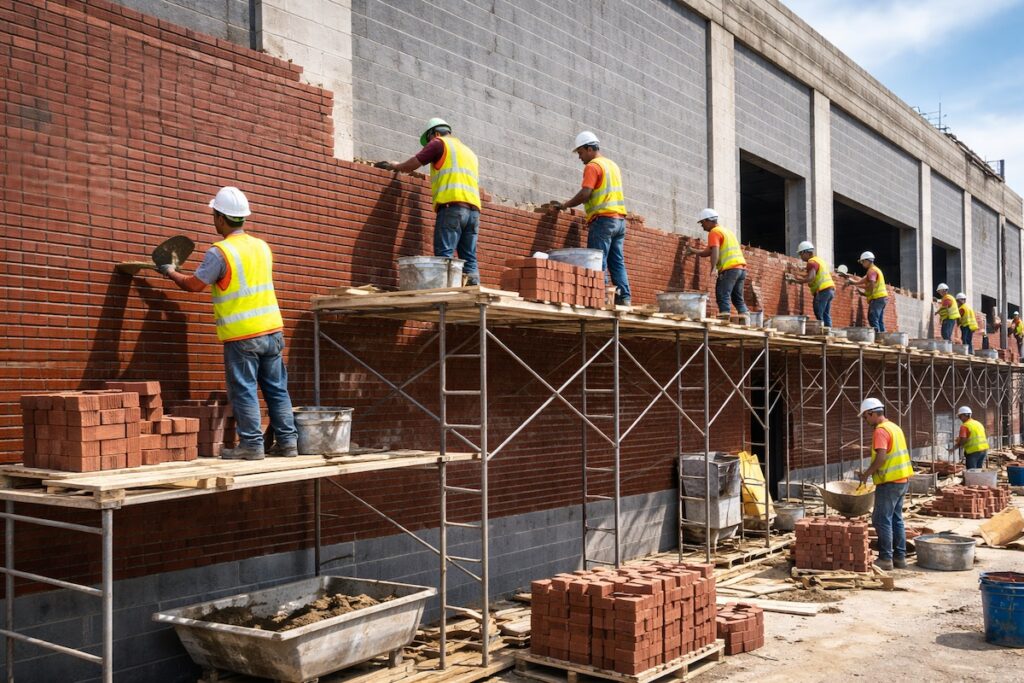
This guide serves as a practical masonry dictionary for commercial construction. It explains commonly used masonry terms in clear, active language and focuses on how those terms apply to real job sites, drawings, specifications, and inspections. The goal is to reduce misunderstandings, improve coordination, and help commercial projects move forward efficiently.
A
Aggregate
Aggregate includes sand, gravel, or crushed stone used in mortar and concrete. In masonry mortar, fine aggregate (sand) plays a significant role in workability and bond strength. Clean, well-graded sand allows mortar to spread evenly and form strong joints. Poor aggregate quality often leads to weak joints, cracking, and premature deterioration.
Anchor
An anchor mechanically connects masonry to a backup wall or structural frame. Commercial masonry relies on anchors in veneer systems to resist wind loads and accommodate building movement. Correct spacing, embedment depth, and corrosion resistance directly affect wall safety and long-term performance.
B
Bond (Masonry Bond)
Bond describes the pattern and overlap of masonry units. It influences load distribution, structural performance, and appearance. Running bond dominates commercial masonry because it balances strength and efficiency while allowing reinforcement placement. Stack bond appears primarily for architectural reasons and requires additional reinforcement.
Brick Veneer
Brick veneer is a non-load-bearing masonry façade attached to a structural backup wall. It provides durability, weather protection, and visual appeal without carrying floor or roof loads. Most modern commercial buildings use brick veneer rather than structural brick, making anchoring and moisture management critical.
C
CMU (Concrete Masonry Unit)
CMU stands for Concrete Masonry Unit and refers to what many call concrete blocks. CMUs form the backbone of commercial masonry construction. Builders use them for load-bearing walls, fire separations, stairwells, elevator shafts, and service areas because they accept reinforcement and grout easily.
Control Joint
A control joint creates a planned weak point in a masonry wall to manage shrinkage cracking. CMU walls shrink as they cure, and control joints direct cracking to predetermined locations. Proper joint placement protects both wall performance and appearance.
D
Damp Proof Course (DPC)
A damp proof course prevents moisture from traveling upward through masonry by capillary action. Commercial buildings depend on properly installed DPCs to protect interior finishes and maintain healthy indoor environments. Missing or misplaced DPCs often result in long-term moisture damage.
E
Expansion Joint
An expansion joint allows masonry to expand due to temperature changes. Brick masonry expands slowly over time, and expansion joints prevent uncontrolled cracking and façade distress. Designers locate these joints strategically along long wall runs and changes in geometry.
F
Flashing
Flashing is a waterproof material installed within masonry walls to collect and redirect water to the exterior. Commercial masonry uses flashing at base walls, shelf angles, parapets, and above openings. When installers block or omit flashing, trapped water damages the wall system.
Frost Resistance
Frost resistance measures a masonry material’s ability to withstand repeated freeze-thaw cycles. In colder climates, designers must select masonry units and mortar that resist moisture absorption and surface spalling to ensure long-term durability.
G
Grout (Masonry Grout)
Grout is a fluid, concrete-like mixture used to fill CMU cores and surround reinforcement. Unlike mortar, grout provides structural strength. Reinforced masonry depends on proper grout placement and consolidation to transfer loads effectively.
H
Head Joint
A head joint is the vertical mortar joint between masonry units. Full, well-tooled head joints improve strength, appearance, and moisture resistance. Incomplete head joints weaken walls and allow water penetration.
I
Insulated Masonry
Insulated masonry integrates thermal insulation into the wall system. Common approaches include insulated CMUs or cavity insulation. These systems improve energy efficiency, reduce condensation risk, and help commercial buildings meet modern energy codes.
J
Joint Reinforcement
Joint reinforcement consists of steel wire placed horizontally in mortar joints. It helps control cracking caused by shrinkage and temperature movement. Commercial specifications often require joint reinforcement in long or highly stressed wall sections.
L
Lintel
A lintel is a horizontal structural element that supports masonry above openings such as doors and windows. Commercial projects commonly use steel or precast concrete lintels. Designers must size lintels correctly and coordinate them with flashing and reinforcement to prevent cracking.
Load-Bearing Masonry
Load-bearing masonry supports vertical loads from floors or roofs. While steel and concrete frames dominate modern commercial buildings, load-bearing masonry remains common in low-rise construction, fire-rated walls, and utility structures.
M
Mortar
Mortar bonds masonry units together and seals joints. In commercial masonry, mortar must balance strength and flexibility. Mortar that is too strong transfers stress to the masonry units, while mortar that is too weak reduces wall performance.
Mortar Joint Profile
The mortar joint profile refers to the finished shape of the joint. Tooled joints compress the mortar surface, improving durability and resistance to water penetration. Most commercial masonry uses tooled joints for performance reasons.
Movement Joint
Movement joints accommodate long-term building movement such as settlement, creep, and thermal cycling. These joints differ from control and expansion joints and require precise detailing to function as intended.
O
Opening
An opening is a planned void in a masonry wall for doors, windows, louvers, or services. Openings require careful coordination between masonry, structural, and mechanical trades. Poor coordination often leads to on-site modifications that compromise wall integrity.
P
Parapet Wall
A parapet wall extends above the roofline and provides safety, fire separation, and architectural detail. Parapets experience extreme weather exposure, so proper flashing, coping, and reinforcement are essential to prevent cracking and leaks.
R
Reinforced Masonry
Reinforced masonry combines masonry units, steel reinforcement, and grout into a single structural system. Builders use reinforced masonry in shear walls, load-bearing walls, and seismic zones to improve strength and resilience.
Render / Stucco
Render or stucco is a cement-based coating applied to masonry surfaces. Commercial projects use render to create uniform finishes or add protection. Without proper drainage and detailing, render can trap moisture and damage the masonry behind it.
S
Shear Wall
A masonry shear wall resists lateral forces from wind and earthquakes. Engineers design these walls with reinforcement and grout to safely transfer loads to the foundation and maintain building stability.
T
Tolerance
Tolerance defines acceptable variations in alignment and dimensions. Masonry tolerances matter in commercial construction because minor errors can affect glazing, cladding, and structural connections. Good workmanship reduces coordination issues and rework.
Tooled Joint
A tooled joint forms when masons compress mortar with a jointing tool after placement. Tooling increases joint density, improves durability, and enhances resistance to water penetration.
W
Weep Hole
Weep holes allow trapped moisture to drain from cavity masonry walls. Builders place them at flashing locations to maintain proper drainage. Blocked or missing weep holes frequently lead to moisture-related façade failures.
Wythe
A wythe is a single vertical layer of masonry. Commercial walls may consist of one wythe or multiple wythes, depending on structural, thermal, and architectural requirements.
Commonly Confused Masonry Terms
Mortar vs Grout
Mortar bonds masonry units and seals joints. Grout fills cores and surrounds reinforcement to provide structural strength.
Brick Veneer vs Structural Brick
Brick veneer acts as a façade and does not carry building loads. Structural brick supports vertical loads from floors and roofs.
Control Joint vs Expansion Joint
Control joints manage shrinkage cracking in masonry. Expansion joints allow masonry to expand due to temperature changes.
CMU vs Concrete Block
CMU is the technical term used in commercial drawings and specifications. Concrete block is the informal term commonly used on-site.
Why Clear Masonry Terminology Matters in Commercial Construction
Clear masonry terminology improves communication across trades, reduces RFIs, and prevents costly errors. When teams share the same understanding of materials and methods, estimates become more accurate, schedules stay intact, and construction quality improves. On large commercial projects, clarity directly affects safety, cost control, and long-term performance.
Conclusion
At Leidal & Hart, we work with masonry terminology every day, from early estimating through final installation. We see how a shared understanding of masonry terms leads to better coordination, fewer issues on site, and stronger long-term results.
Our team believes successful masonry starts with knowledge, precision, and communication. By aligning terminology across architects, contractors, and owners, we help reduce risk and deliver masonry systems that perform as designed for decades. If you are planning a commercial project and want a masonry partner who values clarity, craftsmanship, and performance, the team at Leidal & Hart is ready to support your next build.

